Tag Archives: California

Artist Feature: Wax Roof

We met music producer Wax Roof through our homie and fellow LIFESTYLE collective member Mike Summer. Originally from Santa Cruz and now living in Oakland, Wax Roof discusses the importance of personal experience when listening to music and the unique connections each of us have with different sonic textures. He stays busy putting out solo instrumental records while also working on upcoming collaborative projects with vocalist Genoa Brown and MC Marc Stretch. Peep his words below and check out some tunes from an ill Bay Area beatsmith!

Wax Roof

Your taste and receptiveness to certain sonic textures are the product of a lifetime of experiences, musical and non-musical. No one can take that from you.

– Wax Roof

Leading off with some basics, where are you from? And where are you at?

WR: I am originally from Santa Cruz, and now live in Oakland. I grew up in the Santa Cruz Mountains before going to high school and college in Santa Cruz and finally working and living in the Bay Area. So the migration has gone woods, to the beach, to the town.

What does Reflection and Response mean to you?

WR: Well that’s a really hard question, isn’t it? I mean those are two aspects of existence that are so vast and personal I am not really doing them any justice trying to define them in a cute one liner. I think they mean more than I can ever fully understand, but put simply to reflect is to try to find meaning, and to respond is to try to do something meaningful.

Wax Roof

How does Wax Roof fit in with that definition?

WR: Wax Roof is the ever evolving sum of my journey through the cycle of reflecting and responding to life and the music I witness within it.

Your taste and receptiveness to certain sonic textures are the product of a lifetime of experiences, musical and non-musical. No one can take that from you. It is very unique and in the same way that you search for identity and a sense of happiness [it] is sought through REFLECTION and RESPONSE, so goes your pursuit of music that moves you. Everyone should take pride in their musical taste, whatever it may be, because it is something YOU have created. Wax Roof is the by-product of my taste as a fan for music, who also has the means to create their own.

We are never passively observing culture, we are always creating culture simply by internalizing that which we witness.

What else have you been working on recently? What are you looking to work on next?

Continue reading

Tagged , , , , , , , , , , , , , , ,

Artist Feature: Zach Mack

Zach Mack is a renaissance man from the Bay Area who currently lives in Oakland. Recently deciding to plunge full-time in pursuit of his goals in radio and media, Zach has been producing news stories for various local public radio stations, hosting/creating two standout original weekly podcasts — Dino Pants Radio and The Four Man Rotation — and performing with an improv troupe at the Magic Jester Theater. Throughout our dialogue, Zach drops gems of knowledge accrued through working hard to forward his creative medium. Zach is making moves out here in multiple realms of craft surrounding his interest in radio, and it’s dope that he took a moment to lend his voice to the Collective!

Dino Pants Radio - Zach & Josh

Sometimes its important to just STOP… clear your head, assess your feelings and then act accordingly. Trust your gut but don’t be afraid to seek out advice from people wiser than yourself.

– Zach Mack

Leading off with some basics, where are you from? And where are you at?

ZM: Born and raised in the Bay Area. A California kid to the core, currently living in Oakland. Its a great city that apparently draws a lot of comparisons to Brooklyn. Would love to live in real Brooklyn at some point though.

What does Reflection and Response mean to you?

ZM: Sometimes its important to just stop… clear your head, assess your feelings and then act accordingly. Trust your gut but don’t be afraid to seek out advice from people wiser than yourself. Last year I made the decision to quit my job to pursue this radio-media thing full time. Its been scary, fun, soul crushing, and inspiring all in one; ultimately I know it was the right decision. That response came after much reflection.

I’m still figuring out what works for me but trying to avoid those safe decisions that you know are comfortable in the moment but that you’ll regret in the long term because they don’t challenge or forward you. I recently received some great creative advice; simply put “Always be making.”

mIY5obvPfuRpzXdTdg4lL_PSWu31WN56FkFlk7Hbd2E


PODCAST: Hella Oaklandish Scamming Grandmas (February 22, 2014)

“Our friend Mr. Todd stops by to showcase his new radio piece Hella Oaklandish and talk about everything from scamming grandmas to bad business proposals.”


What else have you been working on recently? What are you looking to work on next?

ZM: Right now I’m immersing myself into the world of radio by helping produce news stories for a couple public radio stations. While journalism is pretty new to me I realize it’s a necessary skill for making good radio, even when it’s not totally news based. Alongside that, I am hosting and creating two weekly podcasts. Dino Pants Radio, a fun show with music and banter, as well as a newly formed sports show for the everyday person titled The Four Man Rotation.

Print


PODCAST: The NFL and the N-word (March 19, 2014)

“The NFL looks to ban the N* word. Is this move progressive or misguided?”


Also, I recently began performing in an improv troupe through Magic Jester Theatre in Oakland. What started as a way to sharpen my wit for radio has turned into a full fledged interest. I find improv to be one of the most life applicable activities I’ve ever taken part in.

Who or what inspires you?

Continue reading

Tagged , , , , , , , , , , , , ,

Artist Feature: Matthew Potter

Matt Potter is a creative writer who grew up in Kentucky and Virginia before settling into San Diego, California. He reminds us that, as artists, we should try to avoid forcing our messages, and instead try to communicate our perspectives in clear ways. Matt also argues that reflection on both positive and negative responses is beneficial to artistic growth, and that past artistic pieces can serve as snapshots of captured Reflection and Response. Woven in throughout the interview below, Matt provides dope perspectives, scenes, and imagery in his poems ColleteCasey’s Last Bat, Night NoisesThe Day Timothy Died, and Three Thoughts on New Orleans. Check it!

Matthew Potter

It is important to reflect on both the negative and the positive responses. Both are going to drive you and hone your craft.

– Matthew Potter

Leading off with some basics, where are you from? And where are you at?

MP: Well, I am an Army Brat, so I bounced around a little. Not as much as some, though. I was born in Fort Knox, Kentucky, but spent my formative years in Newport News, Virginia. I’ve been in San Diego, California for the last thirteen years. I was only supposed to be here a year, but California has a way of dilating time.

What does Reflection and Response mean to you?

MP: In writing, I take it to mean reflection in your own work, or the reflection of others on your work. Often, it takes someone else’s reflection and response to initiate your own. I think as a young writer, it is extremely hard to self-edit (for an old writer too), because you try to put a piece of yourself in that work, and when it doesn’t sync with someone then you want to dismiss them.  When I read my own, or others’ work I ask myself, “What is this trying to tell me?” Not just on the surface but on a deeper level. The point of all art forms is to communicate, so you want the message to be clear. When a poem or story doesn’t work, often the writer’s message is muddled, and the same when my work doesn’t work for others. The best advice I received was from a Creative Writing professor in college. She told us “You can’t jump out of the page and tell your reader, ‘No, you’re not getting it! I meant you to read it this way!’” So, I try to approach everything in that manner, even work e-mails. Granted, there are going to be times where you and your reader are just on different trips, and that same piece will resonate with so many others.

I think it is important to reflect on both the negative and the positive responses. Both responses are going to drive you and hone your craft. Also, I think it is important to go back to old pieces. I have come across pieces I have written years ago, that I thought were great, and came away thinking, “God, did I write this existential piece of crap?” But I won’t throw them away. It is like having a time capsule of your very specific thoughts at that moment.

On a personal level, I probably spend too much time reflecting. It is easy to get caught up in the past and believe you should have done something different. As Jack Kerouac said, “Accept loss forever.” But having said that, I think it is important to take a little time to reflect on your mistakes so you learn from them.

Collete

Oh how I long for a thin-legged French girl named Collete. She would take long drags of her cigarette. Shoot a stream of smoke pushing it through the air, as she rolled her cold black eyes toward a paint-chipped ceiling–exhaling all the stupid things I just breathed into her.

And when she was mad she would huff and stammer in French as she kicked my empty wine bottles across cold wooden floors. She would always be in bed before me, and I would lie on top of the sheets beside her–staring up at our paint-chipped universe alone. Watching Paris spin around me.

And in the morning the sun would breath through pale wind-rustled curtains as shafts of light pry our eyelids open. She would roll over and bury her head in my chest, and we would lie there for an eternity as I engulfed her long dark hair.

How does your work fit in with that definition?

MP: Probably one of the hardest things I find in writing is to have a title that fits your piece, but doesn’t give so much away to your reader. This is probably why I title my pieces after I have written them. It is reflection during the creative process. Occasionally, a title will come to me and I’ll build on it, but it is not the norm. I want to set the tone or a mood with the title, without telling the reader exactly what [the piece] is about. Some of the best poems I have read, Charles Bukowski immediately comes to mind, are ones that have me go back to the title after I have finished reading the poem, and find that the titles are one-line poems themselves. The good ones always make you have that first sip of coffee reaction (the “mmmm. . .” effect). I would love it if my titles could have that response on my readers. I think it is a bit of a cop-out to have too many of your works untitled or have the title be the first line of the poem. Not only for your readers, but for yourself in not reflecting on your piece before you send it off.

Casey’s Last Bat

Every spring, in Havana, when the sugar cane stalks became thick and green

and America still held such promise,

the Dodgers would knock the red clay dust from metal spikes.

Hemingway would breath in the salt soaked air and

run rumrunners down a thick bearded sun burnt throat.

He and Casey would decide who the

Heavy Weight Champion of the World was that night.

Maniacal roar of the home team crowd,

pleading of a Hemingway’s wife,

“Life should be different than this.”

Genius soaked in alcohol and pain,

but he held her tight on warm spring nights

and told her that life was beautiful and worth fighting for.

Shared drinks would bleed into morning,

day’s tomorrow would begin again.

And when October winds had whipped

the baseballs clear of the diamond fields,

Casey’s glove, beaten and worn‐‐sad with the past,

lay stored in an unmarked box in the dark closet.

Casey gathered his strength and lifted not a bat,

but a shotgun and calmly put the barrel to his throat.

Hemingway said, “He did it like a man.”

What else have you been working on recently? What are you looking to work on next?

MP: I have several poems that have been published here and there. I would like to get a collection published. Either a chap book or a complete collection. I’ve found it difficult to gather the ones I wish to see published in a collection and come up with a title for that collection. I would say the majority of it is making the time to make it happen. I certainly use the excuse of life’s minutia getting in the way.

Night Noises

You start to hear everything after midnight

in the middle of the week maybe,

when the summer air is thick and heavy.

The buildings are still.

Breeze pushes trees-rustle of leaves,

loud whispers in the night.

Lonely birds that sing at 2 am,

just when you thought everything was asleep.

The hurried scatter of gravel as the cat rushes through,

chasing a cricket or the moon.


I focus on my breathing, as if hearing it for the first time.

Thinking about every molecule rushing in and out of my mouth.

Squeaking protest of the bed as I try to get comfortable.

The refrigerator suddenly awakened-hums itself back to sleep.

The faucet that rains tepid drops–pling, pling, plop.

A stray car’s tires rolls across cool asphalt.

And somewhere in the dead streets and abandoned beaches

a barbaric yawp tears through the night,

as morning starts to awaken the rest of the world.

Continue reading

Tagged , , , , , , , , , , , ,

Artist Feature: Laurel MacKenzie

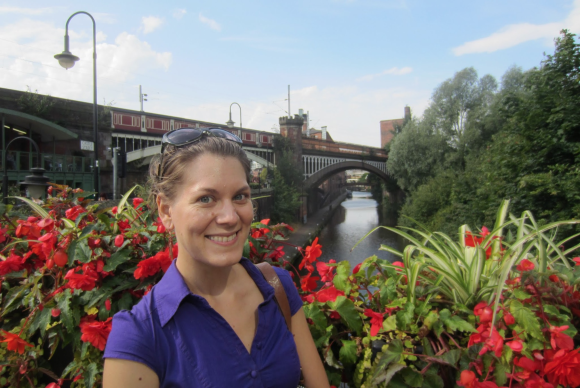
A linguist by training and professor in Manchester, England by trade, Laurel MacKenzie uses the space of her Feature to look at the language people use and how we understand words. She presents thoughts on how instantaneous Reflection and Response occurs and doesn’t occur when we hear each other speak. As an educator Laurel utilizes large lecture classroom settings to provide an opportunity for data collection on language and has created various language maps of the United Kingdom with her students. She drops ill knowledge throughout this piece on how our brains practice Reflection and Response just as sounds reach us-before any creative mediums lead to expression.

Laurel MacKenzie

I investigate the variation that is inherent to language: cases where our language gives us multiple ways of saying something, and we have to make a conscious, or just as often subconscious, choice of which one to use at any given time. We’re most familiar with this kind of linguistic choice where words are concerned…[however,] I study linguistic choices on an even more minute level, in the way we pronounce the words that we use.

– Laurel MacKenzie

Leading off with some basics, where are you from? And where are you at?

LM: I grew up in College Station, Texas, a small town with a big university, a lot of cows, a ton of wide open spaces, and not much else. I did undergrad degrees in French and Linguistics at UC Berkeley (woo go Bears!) and a PhD in Linguistics at the University of Pennsylvania before taking up my current job as a linguistics professor at the University of Manchester in Manchester, UK.

I feel very lucky to get to have a foot in two countries at once. I go back to the US frequently to visit family, and with only 5 hours’ time difference between the UK and the East Coast, I never feel like I’m very far away. At the same time, after a year and a half here, I’m starting to pick up on cultural knowledge and feel more integrated. The result is not that I’ve given up my American self, but rather that I’ve been able to augment it with a new body of knowledge that I’ve gained the UK. I see it as a gift to get to be able to coexist in two cultures. 

What does Reflection and Response mean to you?

LM: My first thought was that this sounds a lot like what we do in academic work. As a linguist, I study and analyze the patterns found in language. This can be as straightforward as listening to the way someone pronounces their vowel sounds and using that to identify where they come from, or more complicated, like studying a body of linguistic data, finding the patterns or relationships it displays, and then using those to generate theories about how language is stored in the brain. Everything I do in my research involves reflecting on data, and responding to what I find in that data.

But I also thought about how reflection and response are involved on a much more subconscious level every time we receive some sort of sensory input. I study language, but I’ve also been a musician since I was a child, playing piano, viola, and carillon (tower bells — another Go Bears! shoutout to the UC Berkeley Campanile), so I’ve always been interested in how we perceive and interpret sound. Whenever we receive an auditory stimulus, whether it be music, speech, or any other sound, split-second reflection and response processes occur, allowing us to make sense of what we’ve just heard. Our brains are amazingly good at this. When you think about it, speech is really messy and complicated: we talk fast, we omit sounds and syllables, different people pronounce words differently depending on where they come from, and even you yourself will pronounce a single word differently depending on where in a sentence it occurs, whether you’ve said it before, how long you’ve been talking, and how comfortable you feel with the person you’re talking to. Yet in the vast majority of cases, we understand exactly what’s been said to us, even if it wasn’t pronounced in the same way we would have pronounced it ourselves. Those reflection and response processes are always going on under the hood, picking apart the sounds that we hear and turning them into something meaningful.

Our brains are also really good at knowing when reflection and response are not necessary. Take the role of pitch in language. In some cases it’s essential to be attuned to the pitch of someone’s speech: imagine the difference in intonation between “That’s a GREAT idea!” said enthusiastically, and “That’s a GREAT idea” said sarcastically. The words are the same in each case, but the pitch patterns are different. Our brains need to be constantly reflecting and responding to these up-and-down pitch patterns that we hear in speech, in order to make sure that we get the right meaning in cases like this. But in other cases pitch differences are completely irrelevant. For instance, some people have high-pitched voices and some people have low-pitched voices, but when we hear a speaker with a low voice, we don’t immediately think “Wait, why is their voice so low? What do they mean by this? Is there something they’re trying to convey?” Our brains can filter that kind of variation out, without wasting time trying to look for any meaning in it. This kind of thing fascinates me, and makes me feel so lucky to get to have a job where I can engage with smart people who are thinking and talking about it.

How does your work fit in with that definition?

LM: I have to say that much of my academic work actually focuses on the aspects of language where reflection often isn’t involved at all — it’s all response, and it’s an impressively subconscious and automatic response, at that. I investigate the variation that is inherent to language: cases where our language gives us multiple ways of saying something, and we have to make a conscious, or just as often subconscious, choice of which one to use at any given time. We’re most familiar with this kind of linguistic choice where words are concerned: for instance, if your professor or your boss gave you some good news, you might say you were “delighted,” but if the good news came from your best friend, you might be “stoked.” I study linguistic choices on an even more minute level, in the way we pronounce the words that we use.

Recently I’ve been interested in the way we can contract verbs in English. If I wanted to prove to you that Manchester isn’t always the grim, gray, rainy place it’s made out to be, I might tell you “The weather’s beautiful right now, the sun’s shining, the forecast for Saturday’s showing 60°, and the tree outside my window’s finally in bloom.” (All true, by the way!) Or I might tell you “The weather is beautiful right now, the sun is shining, the forecast for Saturday is showing 60°, and the tree outside my window is finally in bloom.” The words are the same, but I’ve changed how I’ve pronounced the verb is. Every time we use the verb is in a sentence like this, we have a choice to make: do we lop off the initial vowel and turn it into the ‘s contraction, or do we pronounce the whole word? It sounds like a mundane question, but the cool thing is that, when you actually study people’s choices, you start finding eerily similar patterns.

One thing I’ve discovered is that people are less likely to use the ‘s contraction the longer the subject of their verb is. So if you lined up hundreds of people and got them all to describe the weather exactly as I just did, you’d discover that most of them would choose to say “The weather’s beautiful” and “the sun’s shining” — with contractions — but that most of them would also choose to say “the forecast for Saturday is showing 60°” and “the tree outside my window is finally in bloom” — without contractions. No one ever sits us down and teaches us that that’s the way English works, but somehow we all find ourselves converging on that particular pattern without any reflection at all. The fun and tricky part of my work now is to reflect on why we’re doing that, and where it came from.

What else have you been working on recently? What are you looking to work on next?

LM: One of the most fun parts of my job is that I have a captive audience of students who are ripe for collaborating with. I’ve been trying to use the large (100+ students) lecture classes that are the norm here at Manchester to my advantage, as a way of crowdsourcing data collection. Because our students come from all over the UK, I got them to help me carry out a study last year of regional dialect variation in the British isles: the UK equivalents of the famous “pop/soda/Coke” and “y’all/you guys” divides. My students passed out surveys of a “Do you say X or Y?” nature to their friends and families, and then one of my brilliant undergraduates compiled our findings into this awesome series of dialect maps, which got a great writeup in VICE Magazine’s Motherboard blog back in December (along with a lot of other attention in the UK media). We’ll be updating and improving these maps in the near future, and I just got some funding to start up an outreach program whereby undergraduate volunteers go into local high schools and use the maps to teach students about linguistic variation and dialect diversity.

Lexical Variation: Evening Meal | This map shows which words UK speakers use when referring to the evening meal.

Lexical Variation: Evening Meal | This map shows which words UK speakers use when referring to the evening meal.

Phonological Variation: Foot - Strut | This map shows which UK speakers rhyme the words 'foot' and 'strut.'

Phonological Variation: Foot – Strut | This map shows which UK speakers rhyme the words ‘foot’ and ‘strut.’

Who or what inspires you?

Continue reading

Tagged , , , , , , , , , , , , , , , ,

Artist Feature: Nick Nova

We welcome our friend Nick Nova (born Kwaku Boateng-Farrar) to the LIFESTYLE dialogue. Nova’s creative output operates on many different levels, including music/audio, design, and information distribution. The concept of power is one of the central themes in this artist’s piece as he touches on the re-appropriation of past experiences and memories. Nova provides a dope look at this empowering nature of Reflection and Response in addition to other aspects of his creative process. Check the interview below!

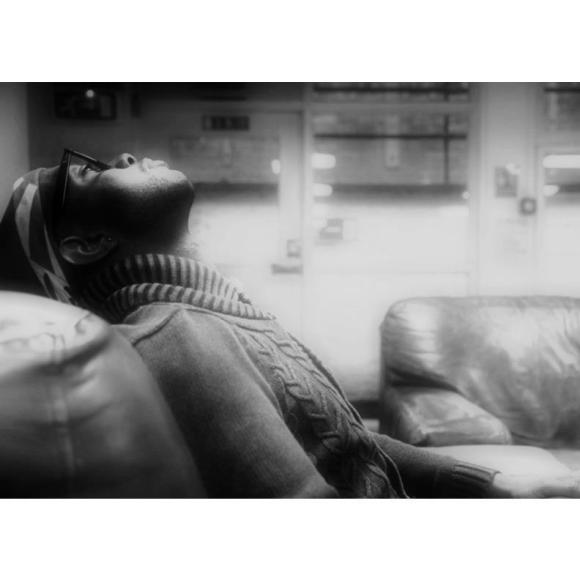
Nick Nova

The ability to reflect on personal experience, past innovations, and current affairs empowers one to respond to obstacles, criticisms and general stressors in a fashion that consciously assists their own progression, as well as that of culture and society at large.

– Nick Nova

Leading off with some basics, where are you from? And where are you at?

NN: I’m definitely a West Coast kid. I was born and raised in Northern California, the Bay Area specifically. After high school I stuck around for a bit before moving to London, England for college. I’m now back in the U.S.and have settled in Brooklyn, NY.

What does Reflection and Response mean to you?

NN: Reflection and Response to me represents the two important, synergistic aspects of creating and succeeding. People often lose sight of self-importance when attempting to achieve greatness in a public space, but the willingness to consider one’s own objectives and mapping out personal checkpoints is vital to the success of projects bigger than its creator. Building on that, the ability to reflect on personal experience, past innovations, and current affairs empowers one to respond to obstacles, criticisms and general stressors in a fashion that consciously assists their own progression, as well as that of culture and society at large.

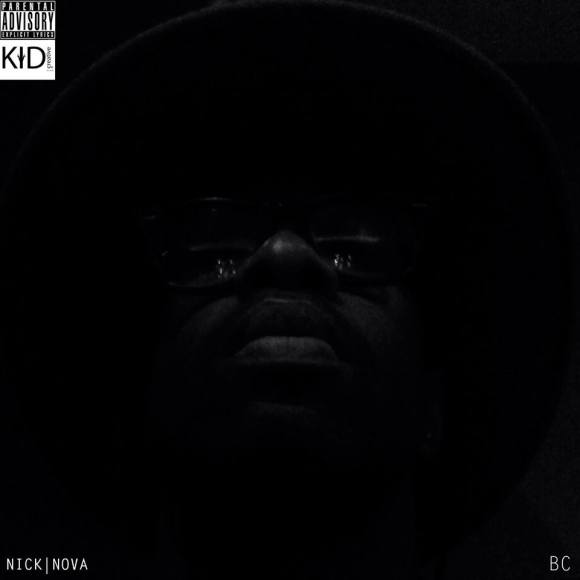
BC

How does your project BC fit in with that definition?

NN: My latest music project ‘BC’ represents this entirely because it is me reflecting on my past, both in the content, as well as the more technical aspect of the project. Recognizing my previous musical inhibitions and seeing how much it hindered my potential, ‘BC’ finds me embracing those flaws and making the appropriate changes to better position myself for achieving my musical goals.

From my observations, it’s common for creators to bury certain aspects of their lives as a defense mechanism, but one doesn’t have a true concept of power until you embrace the most difficult of memories and utilize past pain and/or frustration into something positive and empowering for others. A personal example would be on a record I have called “Tunnel” in which I mention my experience of being bullied. Up until this project I never wanted to share that vulnerability, but upon reflecting on the experience and seeing how much the experience aided my development, I recognized that it was imperative for me to share this so that younger listeners, or even people my age who may be bullied on the job or elsewhere and feel helpless, can recognize their own power through my story and they can stand up to their detractors and even if the results aren’t instantaneous, they’ll know it’s ok to fall down as long as you keep fighting to stand on your feet again, physically and or metaphorically depending on your situation.

What else have you been working on recently? What are you looking to work on next?

Continue reading

Tagged , , , , , , , , , , , , ,

Feature: Keenan Hartsten

For this week’s installment in the Feature Series, we’re honored to present one of our true inspirations: artist Keenan Hartsten. First off, just know that if you’re open to experiencing something new, this one will touch you. The organics of Keenan’s feature are pure and well cultivated—Reflection and Response really gets moving here! It may take a little bit longer to process the energy, but when it hits it’s sure to activate appropriately. You may find yourself off balance at first as it bumps you off the rhythm of the everyday hustle and bustle – don’t sleep though, cause it pounds a direct message—this one packs a big punch. Independence is at the core of the LIFESTYLE movement and the dude Keenan is definitely putting down his indie grind as he creates new spaces and waves in the world. So sit back, kick aside the stress of the week, put on some chill tunes if you please, and digg on his interview along with photos of his various creative endeavors. This one deserves two green-thumbs-up in approval…enough from us though; enjoy and watch it blossom. Peace.

Keenan Hartsten

Reflection and Response is really part of a larger set of processes including absorption/assimilation, digestion, and growth…I feel that to be a well rounded person/artist/liver/lover, you are constantly receiving, receiving, receiving.. especially if you are consciously open to it. I feel like life is there always willing to give, whatever it is that you need to see, hear, think, taste, and ultimately feel…I think that the most interesting thing is the way in which one takes all these seemingly disparate bits and actively responds with whatever is right there, here, now.

– Keenan Hartsten

Leading off with some basics, where are you from? And where are you at?

KH: I originally hail from a town in the middle of the state of Oregon named Bend. It was a beautiful place to grow up with an abundance of opportunities to be close to nature… rivers filled with trout, crystal clear lakes, epic mountains, overall a really amazing place to cut one’s teeth. Needing to see new sights and meet new people I moved to San Diego 7 years ago and have worked to make this place feel like home.

What does Reflection and Response mean to you?

KH: Well, for me Reflection and Response is really part of a larger set of processes including absorption/assimilation, digestion, and growth. I think you could liken it to the act of eating. In order to fuel my body I take in calories through my food consumption. So I’m eating, eating, eating, everyday, all day, chewing, chewing, chewing. Chewing along with saliva, which helps to start digesting the starch in the food, are the first acts of accepting consumable molecules into my body—the first acts of digestion. Once the food is sufficiently chewed, my internal systems start to work by taking those larger molecules and breaking them down into smaller more manageable bits. These manageable bits are then further broken down and ultimately used for their energy potential. I think Reflection and Response are the second and third bits of a trilateral experience of being alive, especially for someone pursuing creative endeavors.

I feel that to be a well rounded person/artist/liver/lover, you are constantly receiving, receiving, receiving.. especially if you are consciously open to it. I feel like life is there always willing to give, whatever it is that you need to see, hear, think, taste, and ultimately feel. For me, the Reflection part of the tertiary equation is that process of digestion; taking these different particles and breaking them down into smaller bits, being present to and appreciating what I have received by letting those things not only come into me but also become one with me. We are given much in life to reflect on and the feedback is always there if I want to look. The Response part of the equation is that process of using what I have taken in and doing something with it. What is interesting for me about Response is that there are all these little bits banging around from all of the time that we are all tapping into. I saw something when I was five, or had a particular experience, only to find that years later in my twenties that experience is still with me and I am responding to it at some level, consciously or not. I think that the most interesting thing is the way in which one takes all these seemingly disparate bits and actively responds with whatever is right there, here, now.

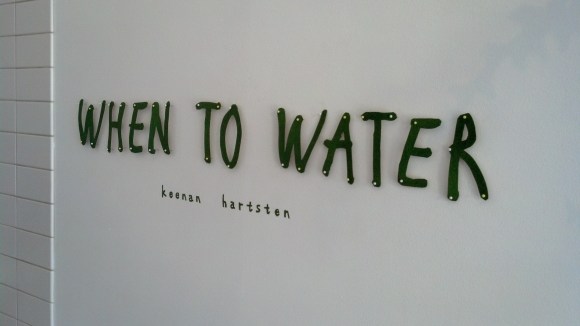
Keenan Hartsten - When To Water

How does your piece When to Water fit in with that definition?

KH: Well, “When to Water” is an installation/exhibition I have up now at my buddy’s coffee shop, the Coffee & Tea Collective. The exhibition is twofold in that I have made an installation on the walls of the space consisting of these floating shelves that accommodate planters which contain all these different variety of plants that work together to create a very crisp, alive essence in the space. The name of the show “When to Water” is very in line with this notion of Reflection and Response. When one is attempting to nurture and take care of a plant, a very important thing to know is when to water. That water is crucial to the energetic functionality of that plant, without it it will eventually wither and die. When you water that plant, the plant is involved in its own version of Reflection and Response: the taking in of that life giving substance to the plant, its cells pulsing with new liquid, and its response in the form of lifting its arms to the sky and driving its roots deeper and further into the soil. The connection between human beings and plants is amazing. There have been countless scientific studies that have pointed to the fact that there is no separation between us and plants; we are both completely sentient beings, and interconnected, affected by our surroundings, in the process of reflection at all times, and responding to all that we are feeling, sensing, etc.

Keenan Hartsten - When To Water

What else have you been working on recently? What are you looking to work on next?

KH: I’m also currently working on some large private garden commissions. I really love that, helping people live with more aliveness in their lives.. plants and creativity and all.

Keenan Hartsten Installation

Keenan Hartsten Installation

Keenan Hartsten Installation

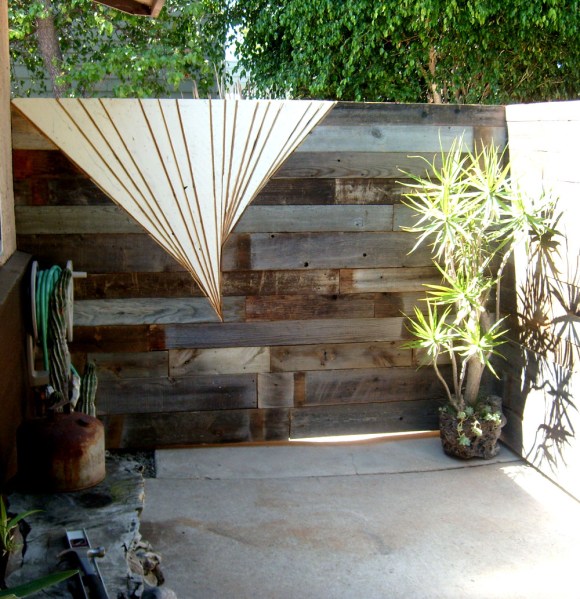
Keenan Hartsten Wood Wall Design

Keenan Hartsten Wood Wall Design

Keenan Hartsten Plant Installation

Too, as part of the exhibition I have currently, “When to Water,” I am throwing a musical gathering and making a crazy handmade instrument to be a part of the event. For the instrument, I have been going to thrift stores buying all kinds of kitchenware/utensils that will be transformed into a percussion instrument. Pots, pans, lids, cookie sheets, silverware, cups, dishes, and utensils are all coming together to form this original percussion instrument. For the gathering I am hosting, I am inviting a bunch of talented musicians to come together and play a percussive set on this instrument, them having never played this instrument before, completely improvised. I am really excited to see how this turns out, the way that all these different pieces sound are amazing.. Wish you could be there to hear!

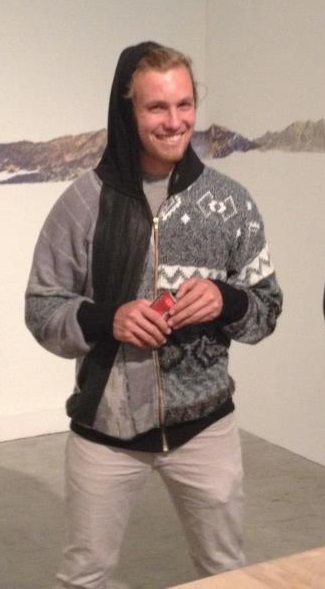
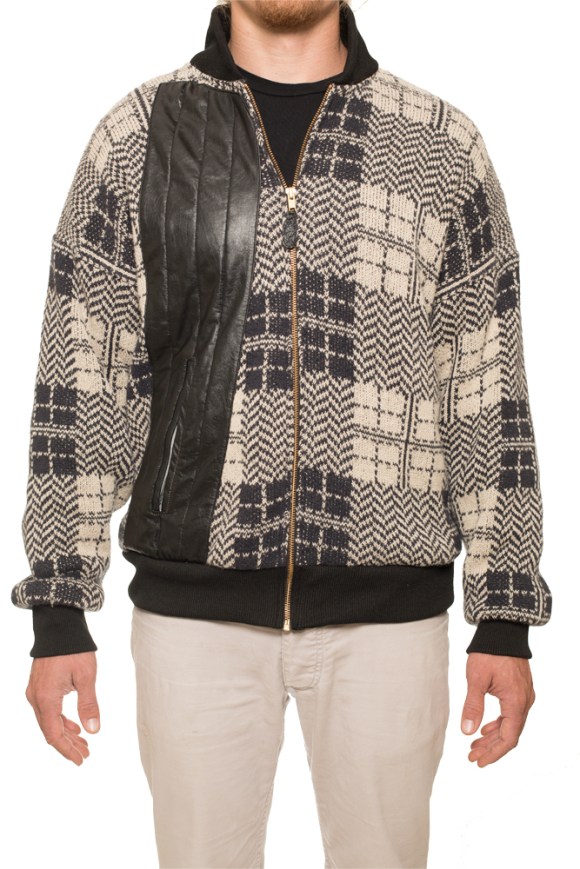
Besides that, I have a line of limited edition clothing, one off clothing I am making called ffiisshh, which can be found at ffiisshh.com. I am taking retro patterned sweaters and cutting them up and remixing them into one of a kind creations.

Keenan Hartsten - ffiisshh sweater

Keenan Hartsten - ffiisshh sweater

Keenan Hartsten - ffiisshh sweater

Who or what inspires you?

KH: I am inspired by much… I think we live in a pretty wondrous world. I am inspired by the hummingbirds that I have been seeing nearly every day without fail. Wow, those little creatures are magic to me! I am inspired by music, always. I am inspired by the people I encounter each day that just seem to be open to connecting, whether through a smile in passing, a quick conversation, or a heart to heart with a friend, sibling, or parent. I know I have talked a bit about this but I am really inspired by plants, I think they are magical and worth being close friends with.

Is there anything else you would like the Collective to know?

KH: That I am proud of what you guys are up to!

Shout out to…?

KH: My mom: Probably first on the list because without her I wouldn’t be half of me.. or me at all in that case!

My dad: Thank you for being a barometer in my life!

My sisters: You always give me room to be but are amazing and supportive.. Thank you!

My roommates: For being great inspiring people to be closely related to.

My Teachers: The many they may be, for helping and encouraging my growth.

Vicken: You’ve been a crystalline example of what a solid man can be in this world.. keep doing your thing and thanks for inviting me into the collective!

Driftwood Wave installation

Reflection and Response.

Tagged , , , , , , , , , , , , , , , , ,

Feature: Jessica Quick

Aright y’all it’s again that time! This week the Collective welcomes Jessica Quick to the Feature series dialogue! Jessica is coming from a place and space unable to be captured by one setting or time. She brings a perspective shaped through elbow-rubbing experiences traversing time zones across the globe, expressed through her creative writing. Anchored in mood and narrating through observation, Jessica takes the time to dive into her interpretation of Reflection and Response, providing a pint of insight into her path thus far. Take a look at her interview and her poem Daffodils below. Enjoy the ride; Bon Voyage.

Jessica Quick

A city’s mood, its mannerisms, its charisma (or lack thereof) reflect in its inhabitants and its architecture, and I like those things to feed into my reconstruction of a city through words.

-Jessica Quick

Leading off with some basics, where are you from? And where are you at?

JQ: I’m from Simi Valley, California, a synclinal suburb squatting outside of Los Angeles. Its geography and demography made it perfect for routine brush fires and a large population of conservative right-ists when I was growing up. It’s an awkward little city, and I’ve come to appreciate its quirks. In doses.

 In the past few years, I’ve lived in Harlem, Seoul, San Francisco, Madrid, and I’ve just relocated to Brooklyn a week ago. I’m looking forward to sticking around and getting back in touch with some old literary haunts, as well as my writing projects. I’m juggling a few ideas, and I think New York is the perfect place to explore them.

What does Reflection and Response mean to you?

JQ: Reflection! A necessary trait of response that’s learned with time, I suppose. I’ve traveled a bit, and it always takes me a long time to arrive at a place where I feel I can appropriately reflect on a city. What I like to do is feel out (and up?) places through my writing. I love infusing their bodies into my poetry. A city’s mood, its mannerisms, its charisma (or lack thereof) reflect in its inhabitants and its architecture, and I like those things to feed into my reconstruction of a city through words. Like getting to know someone new, attaining depth of a place just takes a little time. I wrote about New York when I was in Seoul, about Seoul often when I was in Madrid. And I still haven’t touched my hometown.

How does your writing fit in with that definition?

JQ: Although I like using my travel experience in my writing, I try to avoid relying too heavily on personal perspective. For example, I like creating stories that are not necessarily my own, but in a setting with which I’m familiar. Or I’ll use a mood that I may have felt in a certain city, but explore new lyrical narratives in a poem. I strive towards creation and embellishment over accuracy in retelling my response to a place. Maybe that makes me a liar. But I like telling stories. I think it’s boring and a bit vain if they’re all mine.

What else have you been working on recently? What are you looking to work on next?

JQ: I’m working on my first poetry collection, The Liminal Parade. It’s about spaces between here and there. I like writing about travel limbos, like subways, elevators, long plane rides. I’m also paying attention to certain psychological in-betweenness that mirror in those subways, elevators, and long plane rides – traveling for long periods of time without destination, waiting for someone to arrive, and indecisiveness are things I’m teasing out in my poetry. I like writing about hybrid existences because it hits close to home, both with my travel and with my mixed ethnicity. I’ve dwelled in the in-between and it’s an awkward, beautiful place.

I have a few other projects in mind for the future and the now. I’ve been talking to a few artists about comic book ideas and collaborations on creating some illustrated poetry, which I’m very excited about. I’m a huge comic fan, and the prospect of writing one makes my nerd heart skip a beat.

Who or what inspires you?

JQ: On the topic of comics, Daniel Clowes and Jason Lutes are my favorites for their dark humor and stark aesthetics. The Hernandez Bros. and Chris Ware are also stunning, although Ware makes me want the world to be a better person.

For poets, my current obsession is Frank O’Hara because I spent so much time writing about him for my MA thesis, which compared O’Hara and Lorca’s poetry in New York. I appreciate his unabashed exhilaration with life in his poetry, and how much his personality shows. And if O’Hara were still alive, I’m pretty sure he would be the coolest person in the world.

Of course, big cities inspire me as well as the people I meet. I am indebted to the city dwellers – from the rush hour flautist in Tokyo to my life-long companions. They accompany my memories of the cities I have grazed in my wanderings.

Is there anything else you would like the Collective to know?

JQ: We are poised in an interesting moment in history. From the state of the world economy, to the persistent race for technological advancements and subsequent dependency, we are witnessing rapid change in the world around us. We are responsible for how we choose to respond to these changes. To artists, I encourage you to create something beautiful in reflection of the environment around you.

 Shout out to…

JQ: Big love to all the creators and rabble-rousers. You make the world go round. And a big shout to a very talented jazz musician, my inspiration, and my husband-to-be, Daniel Stark.

Daffodils by Jessica Quick:

Daffodils

The first poem I ever wrote

was written by Wordsworth,

a posture of lines followed by

a school teacher’s request:

“Please see me after class.”


I never showed and

swallowed my first D –

literary theft on record

as enraged or defensive.


Years later, I found myself

writing poem after poem about daffodils.

Bought them any chance I could get.

I filled large suitcases with piles

of laughing heads and moved

to distant corners of the world.


Every town I visited,

I left solitary specimens

behind nondescript buildings

and cheap hotel rooms.

I remember one figure

splayed out like a brown

carcass of envy squatting

on the menu of a fish restaurant

in old Beijing.


After the last, I moved to an island at the edge of a map,

where (they said) daffodils could never grow.

I spent my days planting gardens near tough rocks.

At night, I counted holes in obscure constellations

where great, big, burning stars used to be.

Keep up with more of Jessica’s work at her website: www.jessicaquick.wordpress.com

Also check out Penumbra Magazine, which Jessica co-founded in 2012. She is currently the Poetry Editor for the magazine: www.penumbramagazine.wordpress.com

Reflection and Response.

Tagged , , , , , , , , , , , , , , , , , , , , , , ,

Snapshots from the Collective

Griffith Observatory by Sarah Ballister

Griffith Observatory

Reflection and Response.

The Snapshots From the Collective series works to create a space for Reflection and Response through photography. ANYone who wants to contribute ANY photos to this project can email us submissions at the.lifestyle.rr@gmail.com. One photo will be posted each week, and photos will only be used for the purposes of this series. Thank you and we look forward to building and expanding the Collective!!!

Tagged , , , , , , , , , , ,

Feature: Michele Jules

This week’s Reflection and Response featured artist is Brooklyn-based writer, educator, academic, and social entrepreneur Michele Jules. With a focus on youth empowerment, Michele utilizes dialogue grounded in historical truths to build toward the future. We’re excited to have her voice participate in the ongoing global conversation on Reflection and Response. Check out her interview and an excerpt from her writing below!
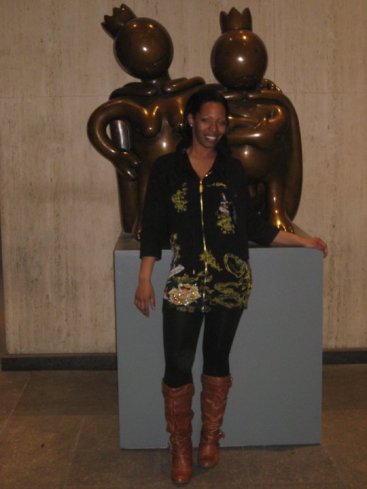
Reflection: Is being able to take in and respect all aspects of art, word and music…

– Michele Jules

Leading off with some basics, where are you from? And where are you at?

MJ: Originally from California, Westside! My dad was a Marine… but was raised in Brooklyn, NY. Both, my parents families are live in Brooklyn. Im a New Yorker at Heart!!

I’ve grown here, failed and succeeded here. I still reside in Brooklyn, but I believe my time here in this city is ending, its time to start another chapter in a new setting, set a new foundation. My family will always be here, New York City is my home.

What does Reflection and Response mean to you?

MJ: Reflection: Is being able to take in and respect all aspects of art, word and music seeing life through others’ eyes. If you can’t relate, you can in some way understand the emotion or point the person is trying to project.

Whether you agree or not, and how it makes you feel and think, your overall reaction is Response.

How does your work fit in with that definition?

MJ: I’m writing my first book, Yay!! I’m all about empowerment of youth, focusing my attention right now on young black women of all ages from their teens to late 20’s and maybe even older.

I see the world through a bigger picture, I’m not the only one on this planet, and I’m at point in my life where I’ve realized, I have to leave something behind and help in projecting better reflections, for the black youth in this world.

And I need help, so I’m sending out a global S.O.S. to black youth, women and men, all over the world. Its a basic interpretation of “If you don’t know where you came from, you’ll never know where your going”, aspect.
I love working with young kids they have so much energy and love for life and laughter. Its important to let them be themselves but be disciplined in teaching them realities of life, their world and the importance of education overall, starting with who they are and where they come from, with no holds barred honesty. That’s the first start to success and the best love story, which starts with yourself.
Young black children have got to see not just their world, but the whole world as a playground. There’s just so many morsels of beauty and genius to take in on this planet.
I’m in total love of this world, my history and I’m also aware of how small we all are compared to the universe, (Let alone the planet Venus), I think that keeps me grounded along with my brutally honest family and friends.
Keeping all this in perspective, I try my best to write realistically and honestly, no sense in sugar coating whats real.

What have you been working on recently? What are you looking to work on next?

MJ: Working on a business with a great partner, catering to fitness and pursuing my M.A. in adolescent psychology. Staying focused with writing, which is so hard when there are so many other distractions.

My next project would be focused on young black men, they are harder targets to reach, but i’m gonna give it a shot, with help of-course!

Who or what inspires you all?

MJ: Faith, inspires me, I have a real relationship with God, we have deep conversations. I also, have a great support system filled with family and friends that keep me on track when I lose focus.

Writing, watching children learn, and empowering confidence in youth, by educating them on their history. I feel I’m doing a devotion to my ancestors by educating young children and families.
And of course to me “life” is so great, If I wake up I’m a happy person, I don’t need much to be happy, it’s the little things that count. If it can be fixed, fix it!.. Life is hard..get a Helmet! 🙂

Is there anything else you would like the Collective to know?

MJI have a dire, deep love for animals, they are they only living creatures on this earth who do exactly, what they were put here to do.❤❤

I am big on Education, it’s power, it’s key and it’s the only thing the government can’t take from you.

Shout out to…

MJ: President Obama and Michelle, I Love you Guys! You show us the true meaning of hope, determination and family…

My family and friends and anyone who have helped in anyway to get me where I am today… You’re Awesome! Hug A Tree, peace! God is Love!

The LIFESTYLE for giving an aspiring writer this opportunity…. You’re Awesome too!

Do You Know Your “Real” History? I Know and Love Mine!

Hello World! 

I’m a proud black woman with a passion for the betterment of my fellow black people, especially our children. I love all people, the world is full of beautiful people, but I hear a cry for help within our communities and in black youth and I’m destined to answer that call or at least reach a few cries before they become silent. I hope you enjoy the topics and please comment as your comments are what keep me aware and connected. 

Sincerely,
An 80’s baby doing her part to help…. 🙂

So… I have come to realize so many black people, no matter what background have no idea about thier history and how great it is. And as some of you may not understand how this comes to bother me so much, I say in my defense that it sets a person back when they have no knowledge of where they come from. The struggles of our people were the highlights of our education, while the unbelievable accomplishments and contributions we have made in history were seldom or irrelevant. I come to understand this from working with black children of all ages, now I single out black children only because I relate to them personally. Our futures are merely a reflection of our pasts and so many young children have a dreadful reflection to look at, but that does not determine who they will be if surrounded by the right influences. “It takes a village to raise a child” parents can do what they can, but sometimes it takes someone else to see the value in that child and encourage achievement.
Community is almost completely lost, hard times are getting harder and uniting seems out of the question! Get your hands dirty, learn about yourself , your history and what qualities you bring to the table. Improvise on them! I was once told if you can do something good then perfect it! Your twenties allow you to get to know yourself and the world around you, as young children our parents guide us the best way they know how, in adulthood is where you truly find your own balance and knowledge for your life ahead.Be proud of who you are and especially of where you come from, if you have children teach them this, dont leave it to the television or other young children to knowledge your child. Get involved! I know that it can be challenging to be a parent but with all brutal honesty, you made the choice or was given the blessing to have a child… Now lets get to work!
We must encourage our youth to love themselves, educate themselves and represent themselves!

Peace and love

Jules

Reflection and Response.

Tagged , , , , , , , , , , , , , , , ,

Events from the Collective

October 2012

  • Wednesday, October 31 @ 3pm-6pm: Diana Cervera (Live Music)
    • Event: Dia de Los Muertos Celebration
    • Location: Youth UpRising, 8711 MacArthur Blvd. Oakland, CA 94605

November 2012

  • Thursday, November 1 @ Midnight: Peter Muller, Vivian Garcia (Open Mic Music)
    • Location: Triskel Tavern, Calle de San Vicente Ferrer 3, 28004 Madrid, Spain
    • FREE
  • Thursday, November 8 @ Midnight: Peter Muller, Vivian Garcia (Open Mic Music)
    • Location: Triskel Tavern, Calle de San Vicente Ferrer 3, 28004 Madrid, Spain
    • FREE
  • Thursday, November 15 @ Midnight: Peter Muller, Vivian Garcia (Open Mic Music)
    • Location: Triskel Tavern, Calle de San Vicente Ferrer 3, 28004 Madrid, Spain
    • FREE
  • Thursday, November 22 @ Midnight: Peter Muller, Vivian Garcia (Open Mic Music)
    • Location: Triskel Tavern, Calle de San Vicente Ferrer 3, 28004 Madrid, Spain
    • FREE
  • Thursday, November 29 @ Midnight: Peter Muller, Vivian Garcia (Open Mic Music)
    • Location: Triskel Tavern, Calle de San Vicente Ferrer 3, 28004 Madrid, Spain
    • FREE

Reflection and Response.

Events from the Collective is a calendar of upcoming events from the LIFESTYLE collective’s international community. Events can be submitted at anytime to the.lifestyle.rr@gmail.com or @LIFESTYLE_RR and will be added to the calendar as they roll in.

Tagged , , , , , , , , , , , , , , , , , , , , , , , , , , , ,